
Lordicon Animated Icons
Building an animation system at the scale of 45,000+ icons.
Lordicon started as a small side project and grew into one of the largest libraries of animated icons on the web, with more than 45,000 handcrafted animations used by over 2 million people.
I founded Lordicon and have been closely involved in shaping its visual and motion direction from the beginning. That included designing animation principles, creating and animating icons, developing new styles, managing product from the development perspective, directing other animators, and figuring out how thousands of individual animations can work together as one consistent system.
Today, the library spans everything from tiny interface animations to interactive illustrations, with assets designed for websites, apps, presentations, social content, and digital products.
- Role: Founder, Creative Director & Animator
- Disciplines: Motion Design, Creative Direction, Product Development, Motion Systems, Brand & Marketing


Designing motion at scale
Animating one icon is relatively straightforward. Making tens of thousands of animations feel like they belong to the same family is a very different challenge.
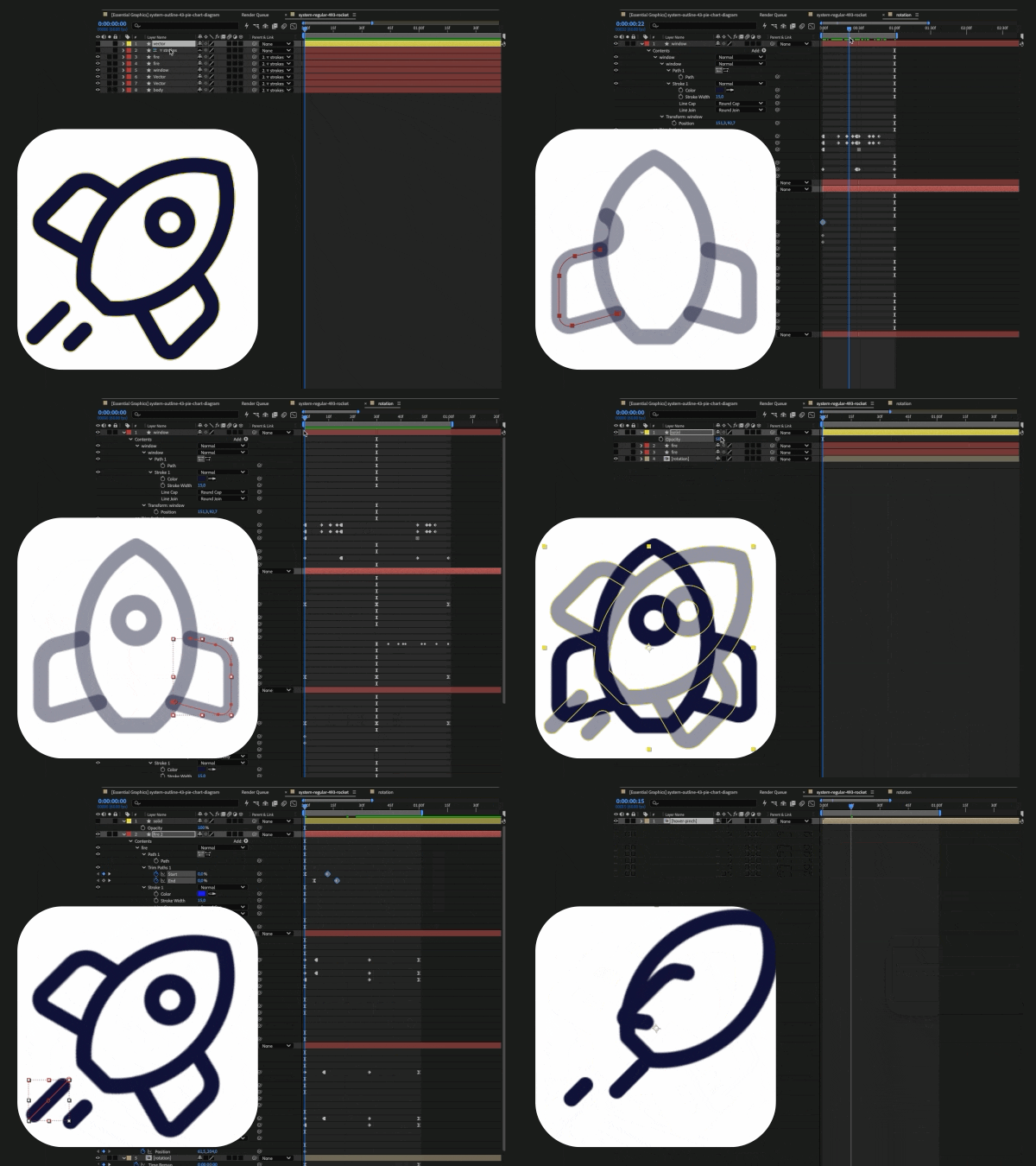
Over the years, we developed a motion language that defines how icons enter, loop, react to interaction, transform, and reveal themselves.
Animations are built around reusable principles for timing, easing, anticipation, overshoot, and secondary motion. At the same time, every icon needs enough individual character to make its movement feel appropriate to what it represents.
The result is a system that can scale across thousands of subjects without making every animation feel identical.

Interactive illustrations
We created a series of interactive illustrations combining multiple animated elements into complete scenes.
Instead of simply playing from beginning to end, these illustrations can react to user interaction and become part of the experience itself.
This allowed us to take the principles developed for small icon animations and explore them on a much larger canvas.
Built for digital products
A big part of Lordicon has always been thinking beyond the animation itself.
The animations need to work in real interfaces. It needs to remain lightweight, scale cleanly, support customization, and give designers and developers control over how they behave.
That's why much of the library is built around vector-based Lottie animation. Colors, stroke widths, playback behavior, speed, delays, animation states, and other properties can be adjusted before an animation is used.
Depending on the project, Lordicons can also be exported and used across formats including Lottie JSON, GIF, MP4, SVG, PNG, WebP, APNG and more.
Where the animations live
Web
Animated icons can bring navigation, buttons, feature sections, pricing pages, empty states, and other interface elements to life. They can play automatically or respond directly to interactions such as hover and click.
Mobile Apps
Small animations are especially useful inside products, where motion can communicate state, provide feedback, explain an action, or simply add a little personality without taking over the interface.
Content
Outside of UI, we use animated icons and illustrations in social media, marketing videos, explainers, advertisements, and other digital content. A consistent animation library makes it possible to build a recognizable motion language across many pieces of content.
Presentations
Lordicons can also be used in presentations, including through our Google Slides integration. Instead of relying on static symbols, presentations can use short animations to introduce concepts, visualize ideas, and make information easier to follow.
Building the Lordicon platform
Lordicon grew into much more than an animation library. We built an entire platform around discovering, customizing, organizing, and implementing motion in real projects.
As an owner, I’ve been involved in shaping the product from its early versions, working closely with designer and developer on the library experience, icon editor, search and categorization, collections, export workflows, integrations, and the many smaller tools surrounding the animations themselves.
A big part of the challenge has been making a library of tens of thousands of animated assets feel simple to navigate. Over the years, we’ve continuously refined the experience based on how people actually search for icons, customize animations, and bring them into their products.
The result is a platform connecting motion design with practical tools for designers, developers, marketers, and content creators.
Growing a creative product
Building Lordicon also meant learning how to turn a creative idea into a product people could discover, understand, and pay for.
Alongside the creative direction, I’ve been closely involved in the marketing and growth of Lordicon. This includes positioning, pricing, product launches, email campaigns, social content, SEO, partnerships, and educational materials.
Much of our marketing has been built around the product itself. Free icons, integrations, plugins, tutorials, motion experiments, and useful resources have helped introduce Lordicon to new audiences while demonstrating what animated icons can add to digital experiences.
Over time, Lordicon has grown to more than 2 million users, giving me the opportunity to work not only as an animator and creative director, but also as a founder responsible for connecting product, design, marketing, and business decisions around the same idea.
From a single animation to a motion system
Lordicon has been an ongoing experiment in what happens when motion design is treated as a system rather than a collection of individual animations.
It has involved animation, illustration, product design, tooling, development, creative direction, and a lot of iteration.
After more than 45,000 animations, the challenge remains surprisingly similar to the one we started with:
How do you make a few hundred milliseconds of movement feel just right?